SoughdoughBread.com FAQ
If you need help, just email me, and you'll get an answer.
How the San Francisco Sourdough Starter Works
Linda,
I've gotten my starter going, and the pancakes from your website are amazing. But the bread has been disappointing so far. Can you help me figure out wonder what I'm doing wrong.
My first 2 loaves were just a couple inches high, and very dense. I figured I didn't let the dough rise enough. So this time, I've had it sitting in a greased up bowl all day. It's risen a little, but only 20% at the most. Should it take over 12 hours to double in size? I live in humid New Orleans, by the way - but my A/C is set to 77 - comfortable and dry.
When I removed the stash from the fridge to start the bread this morning, there was a LOT of hooch, which I poured off. Think maybe my starter is the culprit? I never seem to need to "wake it up" for a long period of time - it bubbles and starts making hooch within an hour or 2 - but I figured that's just because of the warm climate.
I'm thinking of leaving the dough overnight in the hope that it'll miraculously rise. Am I wrong to hold out hope for a doubling in size after 12 hours?
Erin
Hi Erin,
I'm glad that you wrote!
Go ahead and let your dough continue to rise as long as it takes—it will eventually rise enough to bake. If you run out of time, you can cover it well and put it in the fridge which I think will help you to understand what is going on.
How the San Francisco Sourdough Starter Works
Here is my “treatise” on hungry starter—boilerplate that I wrote—but I think it will help you to understand. Its warm in NOLA and your sponge had passed its most active point and the population of yeasties just wasn't high enough.
Believe it or not, your starter is most probably just hungry. When you made your dough, there just wasn't a high enough population of yeast organisms to give you a two-hour rise. If you had just let it at room temperature—up to 12 hours or more—it would have eventually risen. The “No-Knead” breads work like that—with a very small amount of yeast and long rising times.
The San Francisco sourdough starter is incredibly strong and when it is warmed to room temperature, it goes crazy eating and making more babies. When that happens, the new babies get busy and eat even more and make more babies. The warmer it is and the longer between feedings, the more food it needs.
Lots of food is required to feed all these 'generations' of yeast organisms. It's important to keep the live yeast population dense enough so that, when you proceed with making the dough, you'll have enough of the critters to spread throughout the dough, feed on the flour in the dough, and make your bread rise nicely in a reasonable amount of time. In order to get a high population of yeast for your dough, you need to start with VERY VERY active sponge.
Here's what to do: reduce the starter down to ¼ cup and give it a big feeding—three cups each of flour and water—at a time when you can be there to watch it. Look at the mixture every 30 minutes—you will see it get more bubbles and if you stir it, you'll see that it has become thicker and more glutenous. When this happens, if you keep watching every 30 minutes, you'll see even more bubbles and maybe even some foam on top. This is its most active point. If you continue watching every 30 minutes, you will then begin to see the mixture begin to thin out and quiet down, signaling that it has run out of food and is beginning to shut down. This is when the ‘hooch' which is a liquid by-product of the metabolism of the yeast, is formed—making thinner, soupy sponge. You need starter that is at its peak of activity in order to make bread. This is an incredibly active, hungry starter and it's just not getting enough food to allow it to metabolize and reproduce.
I hope I've helped!
Activation
Hi,
I am trying to activate my new SF sourdough starter and am having some
trouble. I started yesterday morning and by evening, I only saw a few
small bubbles. Left it overnight and this morning I saw some liquid,
so followed your instructions and used one cup of the first batch +3
cups water & flour to start over again. Since I was not sure whether
the remainder of my first batch was bad, I fed it as well with equal
amounts of water/flour to starter. Had some bubbles, mainly small plus
a few larger ones in both batches and now they seem to have fizzled out
again.
"Bread Baker"
[Linda]The activation process takes varying amounts of time because of temperatures and other things. If you got some bubbles, then your San Fran starter is definitely alive. Once you see thickening and bubbles, you know that the starter is eating.
They have fizzled out because they have used up all the food that you gave them and are beginning to go to sleep and then die if they aren't fed or refrigerated. When you see bubbles -- large and small -- and thickening, you know that your starter is alive and well and is eating the food you gave it.
[Bread Baker] At no point did I see the amount of activity shown on your website.
[Linda] Don't worry about the website. That shows starter at its most active point. You just need it to wake up and start eating to activate it before you put it in the fridge. You need to get the most active point for your sponge.
[Bread Baker] What do I need to do now? I have used 8 cups of flour so far with the two batches brewing, how much and how long does it take to get this going? Is the starter bad and I need to start all over again?? If I have to leave the house and it is still activating, should I refrigerate it in the meantime?
[Linda] I would recommend that you take out your starter than has been in the fridge overnight, reduce the volume down to ½ cup, and give it a big feeding of two cups each of flour and water. You can do the same thing with each of the two batches you have or you can mix them together. Just be sure that you are feeding ½ cup of starter. You can discard the rest or you can save it to make pancakes.
Linda,
I got your letter. Now this Saturday I may not be able to stay all day as I have to leave at 10:45 for one hour and half and then at 6:00pm in the evening. So I need to plan. Usually, when should I expect to see activity and put my starter in the fridge.? Close to 4 , 6 or 8 hours after I made the mix ?
"Bread Baker"
[Linda] All of the above, depending on the temperature of the water you use and the air in your kitchen. Often, much sooner than later, but I cannot give you a good answer as to number of hours because of the variables.
[Bread Baker] If I start in the morning at 6:00 am and leave at 10:45 for an hour and half, what are the chances I am going to miss it?
[Linda] Probably slim to none. If you see some bubbles and thickening, you can add another cup each of flour and water before you leave, just to be sure.
[Bread Baker]or should I start at 8:00am and when i'll be back at 12:15, I should be good until I leave at 6:00 pm?
[Linda] I think I would start earlier if you don't mind getting up that early.
[Bread Baker] If not, I may have to do it Sunday when I will only be gone for church.
[Linda] Your choice!
Hi Linda,
My new starter does not seem to be as active as the last batch that I bought from you. Any suggestions?
Ed
[Linda] Hi Ed,
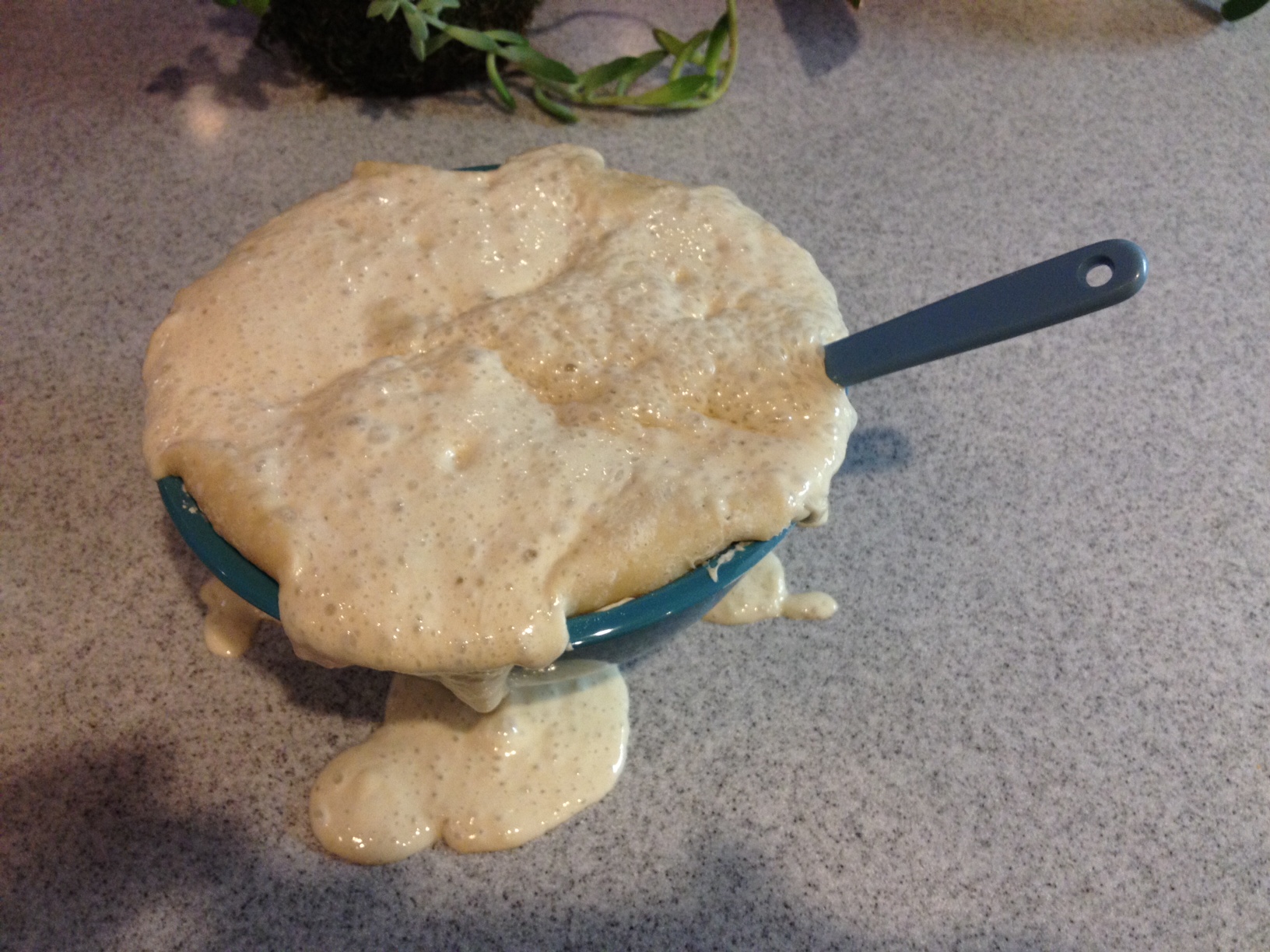
Yes, give it more food! It is exactly the same as the last one and should and will behave like it. But, your conditions might have changed—temperature—timing quantities—or ?? The SF starter is incredibly vigorous and eats up the food you give it very quickly. Actually, starter that isn't active enough is the most common issue bakers new to sourdough face. And it's because the San Fran Sourdough Starter is so strong and vigorous--and needs so much food to keep it alive and multiplying.
[Ed] Hi Linda! You were right! I was not feeding it enough!
Check the pic that is attached! Haha!! Ed
Dear Linda,
Suddenly I am having a problem. During the process when I get past the kneading and in the bucket for the rise nothing happens. No rise at all. How do I tell, if after twelve hours, the activation is right or gone past or short? Thanks,
Al
Hi Al,
The way to tell when you're at the max of activity is, on a day when you can watch it for six to 12 hours, take 1/4 cup of your stash and give it a feeding of two cups each of flour and water. Then be sure to look at it every hour--and every half hour when you see the bubbles beginning. You will see it get very bubbly and thicker and more glutenous. It will stay that way for a while and then the vigorous activity will gradually begin to subside. If you watch it long enough, you'll see the volume shrink slightly and eventually you'll see the hooch liquid begin to form on the top of the mixture.
Here's a link to photos of active starter:
Gluten
Hello Linda,
I'm a'wondering how old your starter is. I know they have to be old for them to be able to sit in the fridge for long periods of time. Yours is so vigorous it's got me to wondering how old it is. I love it, btw! This is my second go round with sourdough, and I've been quite prolific. I've even purchased the pasta maker I've been wanting for awhile just so I can make sourdough pasta. We're reducing gluten around here, and have been insanely enjoying sourdough everything! I made a sourdough cake a couple of weeks ago that was insanely amazing!! So glad you've made your sourdough available. I can tell it's a labor of love for you. :)
Thanks! S
Hello S,
Thank you so much for writing. I got the San Francisco Sourdough Starter that I market from a baker in San Francisco who said he and his family had been using it for many years. I have only had it about 14 years myself.
I am absolutely delighted that you love it—because I do too. I got it for just my personal use, but when I realized how good and strong it is, I just had to share.
And I love that you're making sourdough pasta! That's a great idea. I used to make pasta and now that I'm retired from my “day job” I might do it again. I would love to make it with the SF starter.
Would you be willing to share your recipe with other breadmakers on the Recipes page of my website? If so, I will not use your name unless you OK it. And I would never share any other personal information.
I'm so glad that you're finding the weakened gluten that
the SF starter produces helps you!
Sluggish Rise and Autolysis
I attempted my first sourdough bread last week. It didn't rise properly but I will try again. My question is that instructions said to let sponge with 1 1/2 cups of flour mixed in rest for 30 to 90 minutes (autolysis). I let it rest for 90 minutes but had no idea what to be looking for. Why the time variation from 30 to 90 minutes? Is this why it possibly didn't rise well?
Thanks, Beth
Hi Beth,
If your bread dough doesn't rise as quickly as you think it should, don't give up—just give it more time—up to 12 to 24 hours.
Your sponge probably didn't have a dense enough population to give you three predictable rises, but it will eventually rise—like the “no-knead” bread that starts with a tiny amount of yeast and takes 12 to 24 hours to rise.
Autolysis is done to allow the flour plenty of time to absorb the liquid so that, when you add the remainder of the flour, you won't add too much. You get better holes and texture if you do that. So, you won't see any difference in your dough—nothing to look for. Its not rising well didn't have anything to do with autolysis.
Linda
Slow Starter
Hi Linda.
Got your starter yesterday thru Amazon and started it last night at 10 MDT. This morning I got up at 6AM and checked on it and there was 1/4 inch liquid on top. After reading your FAQs, I figured I missed the boat so I gave it some more flour and water and I saw minimal bubbling. What am I doing wrong?
Thanks, Jim
[Linda] Hi Jim,
I'm sorry I didn't get back to you yesterday. I don't know how your starter is this morning, but the most likely answer is that you didn't do anything wrong. The bottom line is that the SF starter is so vigorous that you just need to feed it more and more often. Please write again—even if it's dead, which is highly unlikely—I'll send you a new one.
[Jim] Linda--You are so right. I fed it 5x yesterday and one big feeding before bed last night and it has gone wild. It is amazing how it is bubbling and foaming.
Thanks for your help...gonna follow same procedure today before putting in fridge. Want it to be real strong.
Thanks again, Jim
Flour Brand / Type
Hi there,
I just ordered the sourdough starter. I am excited to try it. My question is flour? In the store there a several brands,,,, Pillsbury, gold medal and unbleached, bread (type) etc. Is there any that you like better than others. I also was told King Arthur is the best. Please advise.
Thanks! Bill M.
I don't think the brand of flour makes any difference. I have baked with all of them over the years and cannot taste, smell or see changes in my breads. The type of flour is what is important to know about. Bread flour has more protein than all purpose flour so the gluten can be stronger. That's good because the acidity of the sourdough weakens the gluten. Soft southern flour like White Lily has even less protein than all-purpose. But you can still use all three to make sourdough bread with the SF starter. I think King Arthur is a rip-off. I buy my flour from Costco or Sam's and I get 25 pounds for about $8.
Since you're in Sarasota, you'll probably need to keep your large amounts of flour in the freezer. I grew up in Tampa and reared my children in Fort Myers, so I know how the heat and humidity seem to foster bugs in flour. Oh, and I prefer unbleached white flour. I have baked with Kamut and Spelt flours—both ancient flours that haven't been hybridized. Lots of my breadmakers use whole wheat and rye flours for part of the flour in a recipe.
Is is OK to use whole wheat flour instead of all-purpose unbleached flour? If so, how does it change the outcome?
I would recommend using white flour for the activation process because it will then be more predictable for you. Then you can use part or all whole wheat for your baking. Whole wheat bread made with the San Francisco Sourdough Starter never seems to have the sour taste that is so addicting. It also doesn't form gluten as strong as white flour.
Got Hooch? Now What?
Hi Linda...
sorry to be a bother. I was actually ready to give up...but my husband wanted to give it another try, so I took 1/2 c out at about 11:00 Friday night. I gave it 3 cups of water and flour and left it on the counter for the night. By 9:00 Sat morning, there was a serious layer of houch, so I tossed it.
[Linda] Why did you toss it? In a case like this, you would stir it well and either reduce the volume and give it some more food or stir it and not reduce it and give it more food. The hooch is the by-product of the metabolism of the yeast—which means it is very much alive. All it needed was more food.
[Bread Baker] I then took another 1/2 cup of starter out of my jar in the refrigerator, added 3 cups flour and water and stirred and left it on the counter. The temperature in the kitchen was 73 degrees. An hour later I was seeing some bubbles coming up pretty regularly. 1/2 hour after that there was a layer of liquid and no more bubbles coming up.
[Linda] Did you stir it to see what was going on under the surface?
Hi Linda,
I started my starter Friday night and Saturday morning it already had a layer of liquid on it. I concluded that overnight on the counter it had gone past it's best. [Linda] You are most likely correct.
The counter is right about 70 degrees. I mixed the liquid in (are you supposed to mix it in or pour it off?). [Linda] Mix it in
I took part of it out and tried to make pancakes with it, fed water and flour to the rest. I did that a couple time through the day because I didn't feel like it really looked alive. It would be a little bubbly when I first stirred it up, but not like I expected it to be.
[Linda] It probably ran out of food before it had time to feeding, you would have seen much more activity.
[Bread Baker] I knew I would be gone all day yesterday, so I put some in the refrigerator.
[Linda] Good idea!
[Bread Baker] Looking at it this morning, there is a layer of liquid on top...1/4 inch or so. I think that is a good sign and means it isn't dead, right?
[Linda] Yes, that's right. The layer of liquid is hooch and it is one of the by-products of the metabolism of the yeast.
[Bread Baker] I actually put some in two different containers. One had more liquid than the other. Does that mean anything?
[Linda] No, not really.
[Bread Baker] Now what? Does that mean that in all my messing around, I did manage to activate it properly and now I need to just let it sit in the refrigerator a few weeks to develop flavor?
[Linda] Yes.
[Bread Baker] Do I periodically stir the liquid in, pour it off or just leave it?
[Linda] You can just leave it.
Getting a Stronger Sourdough Bread Flavor
Hi Linda,
Having great success with all my tools and the starter! I've been through this process over and again. Your starter has been great. Thanks! I don't know if you have had this question but I cannot seem to get the sour flavor I want and have experienced eating other sourdough. Is this a matter of time? I can wait, but was wondering if I was doing something wrong... Thanks!
Allen
Hi Allen,
To develop more sour flavor in the San Francisco Sourdough Starter, leave a jar of stash in the fridge, undisturbed for about three or four weeks before taking it out and making bread with it. If I want to bake more often, I just keep two or sometimes even three stash jars so that I can use the oldest one if I want it really sour.
Preventing Mold
My other (2 ½ years old) starter started growing a mold of some sort, so I threw it out. Any way to avoid this problem in the future?
You were right to throw out the starter with mold! It's pretty unusual for this San Francisco Sourdough Starter to get moldy. Sometimes if there are drips of it inside the jar above the level of the starter it can be more prone to contamination. Because of that, I empty and wash my jar about every couple or three months. It seems that if the inside of the jar is clean of small drips that mold won't attack the large quantity of starter itself because of the lactobacillus.
Bread is too flat:
Flatness instead of height is always a problem with sourdough. Try adding more flour to the dough, to make it stiffer, for free form loaves. Also try making smaller loaves. I have started making 9-ounce loaves which turn out perfect for dinner for four! I make them free-form and just slightly oval. They are really cute and the slices are a good size for serving, cut off the long side. I also have some bread forms (not loaf pans) that I use for pretty baguettes and fatter Italian-shaped loaves. One is an unglazed clay with a lid in a long but fat loaf shape that I really love. They are pricey....retail for about $50, but it's like baking bread in a brick oven. The others are about $20 each and are made of metal with tiny holes all over it and made by Chicago Metallic. You can find both on the King Arthur Flour site. I bought my Chicago Metallic ones at a local kitchen store (and one at a garage sale!!). You can also get basket-like things that you coat with flour for the last rise and then you turn the risen loaf out on a sheet pan or on a peel to transfer to a baking stone. Commercial sourdough bakers use forms of one type or another--some use floured fabric that is suspended on wooden forms. The point is, you are not alone and you don't have to feel like you're not a good baker if you don't get mile-high loaves like you can get with commercial yeast.
Bread is fragile after rise and will fall easily:
I think you're probably letting it rise too much...either too long or at too warm a temp. for the timing. You should be able to slash it without deflating it, but do try a single-edged razor blade instead of a knife. And dip it in water before each slash.
Bread isn't Browning:
Mix one egg with 1 T water and 'paint' on loaf just before baking. Or leave it in the oven longer. Check the temp of your oven. Keep the oven at 400 degrees the whole time instead of turning it down.
Bread doesn't rise properly:
Use a higher proportion of active starter so that you'll have more yeast organisms. Be sure that starter is at its peak of activity when you use it.
Misc
I have read some information about sourdough bread aiding in the reduction of glucose (sugar) levels. Do you have any information on this subject as it relates to diabetics?
[Linda] I have been told that San Francisco Sourdough bread has a lower glycemic index but I have no proof.
I live across the bay from San Francisco and was told that the cool fog air here is just right for the sourdough starter. Why do they call it "San Francisco Sourdough" when it can be produced anywhere with the right temperature?
[Linda] I guess because it originated there and the specific wild yeast and lactobacillus that make up the starter cannot be captured from the air anywhere else.
Can I make pancakes with this mix?
[Linda] Absolutely! There are recipes on the recipes page of my website!
Hi Linda,
Can you please tell me what type of mixer to get? I am sure you have used several in your bread making travels. Also I would like to know which of the kits to purchase from you. I am just getting started in bread making and will only be doing it maybe once a week at first. I already have two of the bread pans that you recommend, they were a birthday present. Thank you for all of the help.
Sincerely, Tony
Hi Tony,
I must apologize to you for the delay in getting back to you. I was on a cruise for 9 days and just returned home on Sunday night.
Now for your questions. First, I would recommend nothing other than a Kitchenaid stand mixer—the 6-quart 600 if you want to spend that much or at least the 5 quart. Kitchenaid online has an outlet store that sells refurbished mixers. I've bought three of them and have had no trouble at all—they work great and the $ savings is wonderful. Here's a link:
Kitchenaid Outlet
Now for the kits. As you probably know, any job, fun or not, is so much better with the right tools. Assuming that you have mixing bowls and spoons and other very basic kitchen equipment, the tools (they're all toys to me) I wouldn't want to make bread without are: Instant-Read Thermometer, very sharp Razor Knife, Dough Rising container with straight sides, Dough Divider/Scraper, Timer, Cornmeal Shaker, Pastry Brush, Cotton Tea Towels, the Chicago Metallic Double French Bread Pan, a loaf pan, a good Bread Knife, Heavy Plastic Bags large enough to hold round loaves, a jar with a tight-fitting lid for the starter stash in the fridge, and a bowl scraper.
If you get the Breadmaker Basics Tool Kit, you'll get most of these. Or, you can cherry-pick and get the items you want or need, without buying a kit.
Dear Linda,
I've really been enjoying the bread I've been making with your culture. I would like to get bigger bubbles in the bread. How can I achieve this?
Ken
Hi Ken,
To get larger bubbles, your dough needs to be wetter which causes it to need more support, like a loaf pan—or you can let your loaves be flatter, like ciabatta. Longer proofings also encourage larger bubbles, as well as very careful handling of dough after the first rise so as not to flatten the bubbles developed during the rise.
Hi Linda,
I have a quick question.....how long does the first rise take when making bread recipe in your booklet?? It has been 3 hrs and bread has not risen much. It is 69 degrees in my house. This is my first loaf....boo hoo!!
Karen
[Linda] Hi Karen,
I'm glad that you wrote. If your sponge was VERY ACTIVE and bubbly and viscous when you began your dough, then the problem is probably just that 69º is on the cool side. But, even if it wasn't at its peak of activity, you can follow the same instructions, it will just take longer. I'm assuming this is the first rise and your dough is in a bowl with a nice oiled top and covered. If you still haven't seen substantial rising by bedtime, then just cover the bowl well with plastic wrap or something that will keep the top of the dough from drying out. You could add some more oil to the top too. Then, just leave it on the counter overnight. When you get up tomorrow, you should see some rather fluffy dough and you can proceed.
If you see great activity tonight before bedtime, then cover it well, as above, but put the bowl into the fridge so that it will rise more slowly overnight. Either way, you can shape, wait for the second rise (warmed a little if necessary to jump-start it) and bake tomorrow. If you refrigerate the dough, be sure to take it out of the fridge early so that it can return to room temp before you begin shaping.
[Karen] Hi Linda, It turned out great and I have made a loaf since....that first rise takes about 5 hrs here. Both loaves turned out great..beautiful rises. I think the rounding instructions really help. I baked them right on a breadstone w/ cornflour (no other pan. Thank you so much.Karen
Hi Linda,
Help! Help! Must have sourdough!
I've just discarded my second batch of sourdough, and after reading all your FAQ's decided I need some help. I think I've followed your directions, but obviously have missed something. Both times, things seem to be going fine, but the first rise never happens -- the dough just lays there in the bowl. Here's what's happenened both times:
-- Right before bed, I took the stash out of the fridge, gave it a good stir to mix in the hooch, then put a half-cup in a bowl with 2 cups of water (70 degrees) and 2 cups of AP flour.
-- We tend to keep our house pretty cool (about 55-65 degrees), so I've been careful that my proofing box (a draft-free cabinet) is 75-80 degrees.
-- This morning, there were tiny bubbles throughout the sponge and some hooch on the top, and I could see that the volume had gone down slightly. I tossed half of the sponge, gave it another 1.5 cups each of water and flour, and let it rest in the proofing box for an hour. It wasn't as bubbly and active as in your picture, so I think this is where things are possibly going wrong!
-- Ever the optimist, I decided to go forward anyway. After 5 minutes of mixing in the KitchenAid and using your classic recipe, then 3 minutes of hand kneading, the dough seemed just perfect. I lightly oiled my big bowl, lightly oiled the top of the dough, put a tea towel over the top and returned it to the proofing box with lots of good thoughts.
-- 3 hours later, and it has not risen one bit. Sigh.
Doctor, doctor, what's wrong and can my patient be cured? Thanks, Diane
Diane
I'm glad that you wrote. And yes, your babies are alive and can be cured. Probably because you used the 78-80º proofing box, your critters got busy and ate up all the food that you gave them overnight and had already started to lose population (I do hate to say they began to die!). The warmer the ambient temperatures, the faster the critters metabolize and reproduce. So, the lack of rise is entirely due to starting with a sponge that didn't have a high enough population of yeast organisms to make your bread rise fast. Actually, if you had left the dough to rise for several more hours instead of discarding it, it would have eventually risen to double and when you shaped it, it would have risen a second time. The key is the density of the population of yeast.
Here's what you should do next time, in order to get the timing of each rise down to about two hours. The night before, get out your half cup of stash, and feed it with 3 or 4 cups each of flour and water before putting it to bed in its proofing box. The next morning, you should have a very active, very bubbly and glutenous sponge and all will be well.
Hi Linda,
I am eager to get started. I noticed that thewarming drawer in our newer house has a roofing setting. I plan touse it. I willuse the thermometer to see that it is the right temperature. Ican't wait to give it a try! Any tips on making it sour are appreciated.
Rita
I'm delighted that you're excited, Rita! That's just about a guarantee of success.
I think you'll find the San Fran starter sour. After activation, especially if you plan to bake every week, you might want to keep two stash jars in the fridge. It seems that when the stash is left alone in the fridge for two or three weeks, the bread made with it is more sour. So, with two, you can alternate use.
My ovens have proofing settings as well, but I don't usually use them for my sourdough because the longer, cooler rises develop better flavor. You can experiment and see what you like. I definitely use the proofing setting when I'm in a hurry and the house is cool and I'm using commercial yeast.
Hi Linda,
I did the unforgiveable and left my Sourdough Starter in the fridge for a long time without feeding it. Is there a way to save it or do I have to throw it out and get a new starter? I have tried to feed it by reducing it to 1/2 cup and then adding 1 cup flour and 1 cup warm water. It will thicken up and have a few bubbles but it does not get very active. I would appreciate your reply.
Thanks, John K. P.
.
I'm glad that you wrote, John. All is probably not lost. Because you saw bubbles, it's likely that your starter is still alive. Since it has been in the fridge for a long time without a feeding, the population of yeast and bacteria organisms is much lower, so you need to give the babies a boost. Do this: Take about ¼ cup of starter (or less) and put it in a bowl with two or three cups each of flour and water. Stir it and leave it at room temperature. Within a few hours, you should see it beginning to get some bubbles. This means that the small population of critters is beginning to eat, metabolize. Soon they will be strong enough to reproduce. When you see the starter get really active, then you can put it back in the fridge or reduce it one more time to kick up the population one more notch.
This should resuscitate your starter. Please let me know if it doesn't.
Hi Linda,
I started the starter right after I got it Friday, and it was working fine! Really sticky and gooy. Then yesterday after I fed it at about noon, I got almost no action, and watery liquid came to the top. The consistency was about the same as when I fed it. I gave a double feeding over night, there is no smell, and almost no bubbles. I have fed it again a few minutes ago, but I haven't much hope. The water that I have been adding was measured with a thermometer. I used filtered well water, unbleached all purpose flour. The temperature in the box where I am keeping it is at 75 degrees. Don't know what happened. This happened with my first try also! Maybe I'm not destined to grow sourdough. Any ideas?
Jan
Hi Jan,
You are NOT doomed to a life without sourdough. Believe it or not, your starter is just hungry. Hooch is the result of the metabolism of the yeast and lactobacillus organisms. It doesn't look "very active" because there isn't a high enough population of organisms in your starter. Here's what to do: Reduce your starter down to one-half cup and give it a triple feeding of flour and water -- three cups of each -- and watch what happens. You should see it get lots more active, become more glutenous and bubbly and then, after a while, if you don't reduce it down and feed it, you'll see it settle down and form hooch again.
Hello from Madagascar, Linda.
An update from here and a call for advice! I have tried for 3 weekends in a row to make a loaf and so far, not much action. Here's what I have done: The starter is working perfectly. Prepared for Saturday baking with the guideline for Friday night. Next day, by 7am, the action had finished and not much life left in the sponge. I noticed a lot of action on Friday night This weekend, I did the baking prep on Sat morning and watched the starter cranking away and very active. I let it go ahead for several hours, then completed the procedure for baking. Despite a very active sponge, the first rising was ok, but not great. The second one has really not done well at all.
I am using white flour, and when kneading, I added a little whole wheat flour.
The second rise was underwhelming, and my bread was quite dense after it cooled off, but I really liked the taste.
Do you have any suggestions? We are at 4000ft and I have sent an inquiry to the high altitude baking website too.
Kind regards
Christine
Hello Christine!
Based on your well-detailed description of what you have done (a huge help to me!) it appears that you are allowing your sponge to go all the way through its most active state and you don't begin the dough until the activity has slowed down or stopped. I don't think that the altitude has anything to do with the poor rises.
This is a very active, hungry starter, and when it runs out of food, the organisms begin to die—and you don't want that. What I recommend is that you begin the dough when the recently-fed starter (sponge) is at its most active so that you will have a dense enough population of yeast and lactobacillus organisms to give your bread two good rises and a nice spring in the oven. In other words, do whatever it takes to get your starter to its most active state at the time you want to begin the dough. If you need to, feed it double or triple the night before so that the next morning it will be wildly active and ready to eat more flour and water and metabolize when you begin the dough.
Please let me know if you have other questions. You can have great sourdough bread...I promise!
{regarding the second rise} Your dough isn't rising well because there isn't enough food to allow enough yeast organisms to develop in your sponge. The San Francisco sourdough starter is incredibly vigorous and when it is warmed to room temperature, it goes crazy eating and making more babies. When that happens, the new babies get busy and eat even more and make more babies. Lots of food is required to feed all these 'generations' of yeast organisms. It's important to keep the live yeast population dense enough so that, when you proceed with making the dough, you'll have enough of the critters to spread throughout the dough, feed on the flour in the dough, and make your bread rise nicely. In order to get a high population of yeast for your dough, you need to start with VERY VERY active sponge.
You should get two good rises from your dough plus a nice oven spring, which is actually the third rise. Here's what to do. The next time you want to bake, take out ½ cup of stash and feed it with three or four cups each of flour and water the night before. You'll have more than you need, but that should be enough to keep your critters very well-fed until the next morning. What you should see in the morning is a sponge that is full of large and small bubbles and that has a very thick, glutenous texture. If you use that sponge to make your dough, you will get two nice rises.
Hi Linda,
I am a new sourdough bread baker with a dilemma. About a month ago, I activated my sourdough starter and baked my first batch of sourdough loaves. The first batch came out wonderful, and I was excited to try another batch. Unfortunately, I didn't get to try it again until this last weekend. I took out another ½ cup of starter, fed it as the recipe states, and left it overnight in the oven at room temp. The sponge seemed very active, bubbling, and in the morning, had the 'hooch'. I tried to make a batch of dough, but after the 10 min kneading in the Kitchenaid and a half day of rising in the oven at room temp (!) no rising actually occured. I read on your website's FAQ, that I might try feeding another batch of starter with 4 cups of flour and water to jump-start the hungry starter, letting it sit overnight. When I tried it, the sponge seemed alive, bubbling again. Then I started to make the dough the second time, but no rising occurred again.
Do you have any suggestions for me? Could I be kneading the dough too rough in the kitchenaid? Am I forgetting to do something? I hope to make the next batch work -- I'm starting to get a little flustered!
Thanks for your advice,
Kate G.
Hi Kate,
Because the sponge bubbled when you fed it, then it appears that the yeast is still alive and well. I'll be glad to send you a new starter if you want me to, but right now I don't think that will help. The only thing I can think of that could have stopped your dough from rising is overkneading— and I know that can happen because I have done it. In fact, just recently I changed my instructions to read 'knead no more than 5 minutes in the Kitchenaid.'
In addition, even if the kneading time isn't excessive, it appears that the gluten will also break down (which is what causes the dough not to rise if it's overkneaded) if the dough gets too warm while it is being kneaded. So, the first thing I would try is to just knead 5 minutes, after making very sure that you are starting with a vigorously active starter. And the second thing I would do is to keep the dough a little cooler and perhaps add a handful of crushed ice to the dough at the beginning of the actual kneading time.
Something else that strengthens the gluten is adding ascorbic acid -- either in the form of Fruit Fresh powder or crushed Vitamin C tablets. If you're using freshly milled flour, you must have the ascorbic acid so that the gluten won't collapse.
I hope this helps!
Hey Linda,
Still having trouble with my starter. I tried to make bread again and the dough barely rose. Earlier in the week I took the starter out after work several times and gave it a good feeding by keeping one half cup of starter and mixing in a cup of flour and water. It doesnt bubble up like before and it seems like it makes alot of hooch very quickly. Last night I took a half cup and added 2.5 cups of flour and water for the sponge. This morning it had almost a half inch of hooch on top. What is going on with my starter?
Thanks,
Rich
Hi Rich,
I'm glad that you wrote. Believe it or not, your starter is just hungry. Hooch is the result of the metabolism of the yeast and lactobacillus organisms. Your dough won't rise because there are't enough yeast organisms in your sponge. Here's what to do. Early on a morning that you'll be home for several hours, take ½ cup of your starter and feed it with 2.5 cups of water and flour. Note what time it is and then watch it. You should see it get more active, become more glutinous and bubbly and then, if you don't feed it, you'll see it settle down and form hooch.
It appears that your room temperature is warm enough and your starter vigorous enough to completely use up all the food from a big feeding in record time.
Here's what to do. The next time you want to bake, take out ½ cup of stash and feed it with four cups each of flour and water. That might be enough to keep your critters fed until early the next morning.
Let me hear...I care!
Cheers,
Linda
www.SourdoughBreads.com
I am in the process of activating my starter, and I have a couple of questions. I have a 2 quart glass wire bail jar. Can I keep that much starter in the refrigerator? The recipes for pancakes on your website call for 1 cup of starter, well, when you have your son, daughter-in-law, three hungry grandkids, your wife and yourself to feed, that 1 cup ain't gonna cut it. I assume I just double or triple the recipe. You now see the reason for question #1.
I have fed the starter for the first time. Do I dump out all but 1/2 cup the next time I feed or do I wait until after the 72 hours? Instead of throwing it out, can I take another 1/2 cup and use it for another batch? (For my daughter-in-law)(Not trying to take business from you, but I know that she would never start it herself.)
Thanx in advance for your help. BTW, I won't forget to leave the EBAY feedback!
Chuck
Hi Chuck,
I'm glad that you wrote. You can keep as much starter as you want in the fridge. But, go ahead and finish the activation because it's actually much easier to make huge amounts of starter with fully activated starter.
Yes, you must reduce the volume before each feeding during the 72 hours of activation. Throw it out! When activation is finished, then give your daughter-in-law a cup of fully activated starter and she can use it right away.
Yes, just double any recipe you want. To get more starter for pancakes in the morning, take out about half a cup of your stash the night before and add as much flour and water as you want, usually in equal proportions, so that you'll end up with enough batter for pancakes the next morning. In other words, mix a half cup of your refrigerated stash with three or four or even five or six cups of flour and water and you'll have fully active huge amounts of batter, ready to have your other ingredients (eggs, salt, baking powder or soda, etc.) added for pancakes.
Please write again if you have other questions!
Good Afternoon Linda,
I've been reading your website FAQ. I'm interested in purchasing your sour dough starter, but I can't eat white flour. Do you sell starter made with wheat flour?
Thank you,
Patty
Hi Patty,
When you order the San Francisco sourdough starter from me, you can 'activate' it (bring it out of hibernation) with the 100% whole wheat flour of your choice.
I ship the starter dry, and you'll receive less than a tablespoon, so that by the time you finish the activation process, there is virtually no white flour left. You can read about the activation process in my online Instruction Booklet at
https://sourdoughbreads.com/sourdough-starter-help.php
The really important part of the starter is the two microscopic organisms it contains—the reason for the small amount of dry starter you receive. Even a teaspoon of dry starter contains thousands—maybe millions, who knows??—of very much alive—but sleeping—wild yeast and lactobacillus organisms. When you add water and wheat flour, the tiny organisms wake up, begin eating and reproducing themselves, and voila', you have very active starter to make your bread with.
If this doesn't make sense, please let me know, and I'll give you more detail.
Hello Linda:
I NEED HELP, please. I haven't used my starter for a couple of months. It has been in the fridge, and got that grey hootch on the top, which I stirred back into my starter. Yesterday I took some of my stash, fed my remaining stash, let it set out at room temp for an hour & a half, put the water and flour in the stash I took out. Last evening I added 2 and a half cups of four and water covered it with a damp towel and set in my microwave (no drafts) until this morning. It had kind of separated with some of the light looking hootch on top, and I stirred it back in and added 2 cups of flour and water to start making my bread. There were a few bubbles of activity when I took it out this am, but I was worried that there were not enough. My bread is together now in the oiled bowl, but is not showing any sign of raising. Do you think my starter stash has died? Or what am I doing wrong? Thank you for your help.
Doreen
Hi Doreen,
If you haven't fed your starter in a couple of months, so many organisms have died that you just don't have a dense enough population to make your dough rise.
Here's what I recommend: Take about a half cup of starter, put it in a bowl with 2 cups each of flour and water. Cover it and let it ferment until you see some activity. Then repeat the process—two or three times, each time, reducing the volume to a half cup. This process will help your starter build up its population of yeast and lactobacillus organisms. Each time you do it, you should see it get active sooner and you should see more vigorous activity as well.
Never try to make sourdough bread without a VERY active sponge. If you'll feed your stash at least once a month, then you'll always be able to start with an active sponge.
Hi Linda,
Just finished the activation steps with your starter and ready to bake.
The recipe in the instructions calls for taking ½ cup starter, adding 2.5 cups water and 2.5 cups flour – let sit overnight – this is the sponge.
Then the next day, take 2.5 cups active starter (the sponge) and …….
My question is – do you mean the entire sponge (which is more than 2.5 cups, or do you mean measure out 2.5 cups of the sponge, and do something else with the rest?
Thanks
Mike
Hi Mike,
I'm glad that you wrote. I guess I'm a little extravagant with flour and water. You can use ¼ cup of your starter and add only 2 cups each of flour and water, and you'll still have a little more than 2.5 cups to bake with in the morning. Put what's left in your jar and put it in the fridge, since it's been recently fed.
I hope this helps! Have fun with your breadmaking!
Hi Linda
I bought your sourdough starter in early 2006. I really enjoyed the bread. I was deployed to Afghanistan last year and I recently returned to Virginia Beach. I've tried (unsuccessfully) twice in the past month to bake loafs but they haven't risen. The stash still has the sour smell when I leave it at room temperature and it still has a lot of bubbles when I make the sponge, but when I add flour to make the dough, it doesn't rise. I was away from home for about 11 months. I don't know if the culture died, or not. What do you think????
Thanks, Benny
Hi Benny,
First, thanks for serving me and our country. I'm glad that you're back safely.
Amazingly, it sounds like your starter is still alive. So many organisms have died, however, the you probably just don't have a dense enough population to make your dough rise. Here's what I recommend: Take about a half cup of starter, put it in a bowl with 2 cups each of flour and water. Cover it and let it ferment until you see lots of ood activity. Then repeat the process—two or three times, each time, reducing the volume to a half cup. This process will help your starter build up its population of yeast. Each time you do it, you should see it get active sooner and you should see more vigorous activity as well.
I hope this will help!
Linda,
I have a question for you. I got my starter flakes in the mail Friday.
I have spent the whole weekend feeding them every 8 hours. I know the yeast is alive because about an hour after I feed it there are lots of bubbles and a froth on the top. It is even starting to have that old familiar smell to it. Anyway, I used a cup of my starter to try to make some bread dough. I remember when I had my old starter the dough would more than double in size overnight. I would punch it down, form it into loaves, and 8 hours later the dough was spilling over the edges of the loaf pans. Well, the dough I made last night was only about 30% larger this morning. I punched it down and kneeded it again and made loafs and just called my wife and she said the dough has not yet reached the edges of the loaf pan.
Why do I have lazy yeast and how can I make them more energetic?
Mike
[Linda] Hi Mike,
I'm glad you wrote. I think your lazy yeast is actually hungry and part of the yeast population is dying in the 8 hours between each feeding. On the second and third days of activation, you probably should be feeding every 4 hours. Here's what to do: Take a cup of starter and feed it a cup each of flour and water. As soon as you see it get active...probably in an hour or two, reduce the volume and repeat or...don't reduce the volume, if you want enough to make bread, and give a feeding of 2 1/2 cups each of flour and water.
Starter that is this active should make dough that will give two good rises and good oven spring as well. It may be quite different from the starter you had before in terms of its appetite. When I make bread with this starter, the first rise takes about 2 hours and the second rise about the same. If you start with really active starter, I'd count on the 2 hour rises.
[Mike] Yes, that fixed it. Thanks!
Hello again Linda
Yes I have previously ordered a couple of months ago I believe. Let me tell you that a lot has happened since I received my starter from you. Never before have I given such care and attention to a living thing since my children were born. My starter is an absolute marvel to behold and I usually have two or three different batches going at any given time.
In the beginning, I simply used to toss any extra starter down the drain during feedings but now it has become so precious I can hardly stand to waste it. As a result I believe I may have eaten about 1000 sourdough pancakes as a result. I never even knew sourdough pancakes existed until I started researching recipes. Now it's very rare for any starter to hit the drain. I have also made several loaves of the most awesome bread in my bread machine (Thanks so very much to Joe Wagner for his great e-mails)!!
I guess now would be a good time for a couple of questions. First, I'm a little curious as to what the proper texture of the starter should be. I consistently use the 1:1 ratio of flour to water and it seems a little thin… about like pancake batter. Also, does it matter what type of flour I use?? I started with Gold Medal all purpose but recently switched to White Lily unbleached bread flour and my starter seems to prefer the White Lily with better feeding action and a better aroma for sure.
Second, I use a large glass Pyrex bowl for my feedings and my question pertains to the plastic wrap. Do you seal the top of the bowl air tight or do you just drape it over?? I have been sealing mine air tight however sometimes I'll lift an edge of the wrap to let it “burp” a little.
O.K. Now for an observation/tip that may prove useful to us sourdough “newbies”. I discovered that it is far easier to wash the starter off bowls and utensils with cold water first and then follow with hot soapy water. This makes a huge difference in the cleanup process and your drain will thank you for it too!!
Thanks again Linda for your wonderful product and excellent website. I'll be trying my hand at making loaves by hand soon and I'll let you know how it goes. O.K. I better get going as I just heard my favorite sound… the bread machine is beeping!! Another loaf is born…
Anyway, It's obvious that sourdough cookery is more than a hobby Linda… it's an absolutely wonderful addiction!!
Randy
[Linda] Wow… such great info. I love it!!
[Randy] It makes sense about using bread flour as opposed to all purpose etc. The main reason I asked is because my starter took on a whole new personality when I switched from all purpose to bread flour…. It became A LOT thicker and more glutenous (is that even a real word?). But of course it makes sense as the bread flour has a higher protein content. Anyway, long story short… my starter is very happy with the bread flour and also my loaves are coming out better for sure!! I just got done snacking on the “end” of a newly hatched loaf (bread machine). It just doesn't get any better than an “end” covered with real butter while still warm. And the genuine San Francisco sourdough taste… Linda there is no way to explain eating genuine SF sourdough in my Kentucky kitchen… that I made myself!!
[Randy] I like the tea towel idea also. Plastic wrap just doesn't look right anyway. Also, I appreciate the tip about a little extra flour for the free form loaves. Can you knead this dough too much?? I get a little concerned about overworking the dough but like everything else… practice makes perfect huh??
[Randy] And yes… please feel free to use any and/or all of my e-mails on your website. What better way to learn than by the experiences of others huh?? Actually, I can attribute some (most) of my success with the bread machine to Joe Wagner's e-mails.
[Randy] Anyway, I believe it's time to go get another slice of that fresh loaf so I'll close for now.
Thanks again Linda, Randy
[Linda] Thank you so much for your great feedback. I just love people who are as nuts about sourdough as I am…and it definitely sounds like you're thoroughly hooked.
[Linda] May I have your permission to post some or all of your text on the FAQ and Reviews pages of my web site? So much of what you say is not only informative but also encouraging to newbies.
[Linda] Now for your questions. After you have baked enough with sourdough starter to understand what you're doing and how it behaves, you can keep your starter at any consistency that you want—from about like pancake batter to very thick, but not quite dough, and it won't matter to your yeast and lactobacillus babies. The only difference will be that you will adjust your amounts of ingredients as you make your sponge and then your dough.
[Linda] As for flours, that's a different story. You will get distinctly different results with dough made from all different types of flours, but all will be acceptable in my opinion. I buy bread flour by the 50 lb. ($9!!!) bag at Costco or Sam's, so I tend to use it for just about all steps. For free form loaves, bread flour, which is higher in protein, will give you a better, more predictable shape than the all-purpose, which has a lower protein content and doesn't form gluten that is as strong as that formed by the use of bread flour. That said, use what you like!
[Linda] I too use a large glass bowl for my feedings and I used to use plastic wrap to cover it. I have now gone back to my grandma's practice, before plastic wrap existed, and I use a cotton tea towel to keep out bugs and dirt. That's why I started selling the tea towels on my web site. The cotton towel is sooo much easier to handle than that *#$@$!! plastic wrap and it looks much better too. When my sponge is in my mixer bowl, the towel is large enough to cover the top of the KA mixer and the bowl too! Plus, it's reusable! With all that, the answer is, leave it loose so it can breathe! ?
[Linda] Two more comments—one you asked for and one you didn't. You're absolutely right about the clean-up of sourdough stuff—I always let everything soak in cold water and then it comes off easily. But it is sticky stuff—much more so than ‘normal' flour and water. You're also right that I should warn people about it!
[Linda] When you make your ‘free form' loaves, be sure to add a little extra flour for a slightly dryer dough—not sticky—and knead very well. If you don't, your free-form loaves are likely to ‘rise sideways'—in other words, flatten out, instead of rising up and making a nicely rounded loaf.
[Linda] Let me hear! And thanks again for the great communication!
Hi Linda,
A suggestion for your proofing box..........I use my infinite adjustment halogen task lamp that I borrow from my office desk. The infinite adjustments allow me to easily adjust the temperature inside my cooler to my desired temperature.
Mike
Hi, Linda.
I've begun the sourdough starter process. I'm not much of a baker so I'm having a bit of trouble with the instructions. On page 3 "Feeding Your Starter" is where I get confused. The terminology about critters and metabolism mystify me. So, I'm not sure what I'm looking for. Is there access to directions written a bit more like I'd find in a cookbook? Something like: after 4 hours add 1 cup of flour and 1 cup of water.
[Linda] Unfortunately, with sourdough baking, you can't write instructions like a ‘normal' recipe, because everything depends on everything else. What you're doing is bringing two different one-celled organisms out of hibernation with the moisture and feeding them with the flour and water so that they can eat and reproduce. Once they start that process, I think you'll have a better idea of what you're dealing with and perhaps see why I wrote the instructions the way I did. The one-celled organisms are the ‘critters' and metabolism is those critters eating and exhaling (which makes bread rise) and reproducing and making more critters so that you'll eventually have enough yeast and lactobacillus organisms to make your bread rise and make it taste good.
[Bread Baker] Since I'm not understanding "critters" and the activity I'm supposed to observe, I guess I'm asking for something more traditional. Also on page 3 it indicates that: "at about the peak of activity, stir the mixture well and then pour out all but about a cup of the starter and feed it." I'm sorry to be so dense, but am I throwing away all but a cup?
[Linda] Yes, that's exactly what it means. Throw out all but one cup of the starter.
[Bread Baker] I appreciate your help. Again, my apologies for all my questions. The only time I make bread and rolls from scratch is when I use my bread machine. So, I'm a real novice when it comes to the real deal. Thanks so much.
[Linda] You don't need to apologize. Tech support—unlimited—is free...and I'm glad that you wrote. I want everyone who has my starter to be successful at baking wonderful sourdough bread in their own kitchen—and you can do it! I promise. Just write any time you have a question.
Hi Linda,
I have been feeding my new pets and am ready to bake my first loaf today but I have a question that I have wondered about for a while. I have been making bread for about 5 years by grinding my wheat fresh and have been quite successful. It really is delicious and very healthy. My question is about the use of a pizza stone. Do you shape the loaf and let it rise on the stone and then put the whole thing in the oven or let the dough rise on a pan and then transfer the loaf and how do you go about doing that without deflating the risen dough. I have a pizza stone but have never really used it much. I can't wait to bake my first loaf. I will let you know how my fresh ground wheat does with the sourdough starter.
Thanks for the help. Connie
I'm glad that you wrote and that you are enjoying your new pets. The easiest way to use the stone is to put it in the oven when you begin to preheat. Then put the pan that your shaped and risen dough is on directly on top of the stone when you put it into the oven.
When you've had a little practice in shaping and rising and know how your dough behaves and exactly the right time to bake it, then you can shape your loaves on a baker's peel that is dusted with cornmeal and, when rising is finished, use the peel to slide the loaves directly on to the hot stone. For obvious reasons, I don't recommend this at first.
The stone does a lot to stabilize the temperatures inside your oven as well as making the bottom of your bread very crusty, even if it's on a pan and not directly on the stone. Congratulations on grinding your own wheat! I'd love to know how you like using the sourdough starter with it.
I would like your opinion of the use of citric acid with your sourdough. I am looking for the san francisco sour taste. Will your starter produce this with the addition of nothing else or may I have your suggestions.
I use ascorbic acid (Vitamin C) in my breadmaking -- sourdough or not -- because it prevents a problem from occuring in freshly milled flour that weakens the gluten bond -- and gluten is what gives your dough the strength to hold a rise. You never really know if your flour is aged or freshly milled, so I just add the Vitamin C whenever I bake bread. In sourdough it's just more important because the acidity of the sourdough tends to weaken the gluten somewhat anyway. Citric acid is not necessary to get the characteristic San Francisco sour taste -- the lactobacillus in the starter takes good care of that.
Since you live in Texas and we all know that there are wild yeasts in the air everywhere, won't your starter change from a San Francisco Sourdough Starter into a Texas (or Oklahoma, or Maine or Virginia or Oregon) starter as I use it where I live?
Good question. If the starter I sell had been 'homemade' here in Texas and I sent it somewhere else, it might eventually take on different characteristics because most sourdough starter recipes you see tell you to just mix up flour and water and let the wild yeasts that are in your local air do their work.
The symbiotic combination of wild yeast and lactobacillus that make up the genuine "San Francisco Sourdough" starter culture is unique and readily excludes other wild yeasts and other friendly bacteria (lactobacilli). There are jillions of 'starters' out there that will leaven bread and even give it a sour taste. But the particular wild yeast, classified as Candida milleri, and the lactobacillus classified as L. sanfrancisco, both of which are contained in the starter I sell, are very special when they are together and they blatantly snub friendly overtures from other wild yeasts and lactobacilli.
There is a nutrient found in wheat flour called maltose. Candida milleri yeast is unable to use maltose. Funniest thing--the lactobacillus L. sanfrancisco loves to eat maltose and actually finds it essential for survival -- it can't live without it. So the wild yeast and its partner lactobacillus don't compete for nutrients when they're hanging out in a delicious nutritious flour and water mixture -- they actually help each other thrive. (Regular commercially available baker's yeast loves maltose and would eat it all up so the bacteria would die!) In addition, this particular lactobacillus produces an antibiotic that actually protects the culture from contamination.
Both this yeast and lactobacillus also grow best in an acid environment -- like a sourdough culture. But an acid environment actually inhibits the growth of most other yeasts, especially commercially available yeast. Most other lactobacilli really hate an acid environment too. So, now you know why a San Francisco Sourdough Starter can survive in Texas and stay pure. It is very difficult to contaminate it with the randomly available wild yeasts that are all over everybody's air. It keeps itself pure.
I didn't make this starter. I got it from someone who got it from a baker in San Francisco.
I am not sure what I am doing wrong, but my loaves tend to be very flat and dense. I let the dough rise for two or three hours, form the loaf and let it rise again for another couple of hours. I suspect that I am not adding enough flour to the sponge when I make the dough. The first loaf I made did not have much of a sour taste at all, but the second and third were progressively more sour. Is this normal? Does it have some-thing to do with the "hooch" that forms on the top of the stash? Thanks for your help.
Michael
First for flat loaves -- they are common for 'freeform' bread -- and especially sourdough. And you're right, adding more flour will give you more structure and, therefore, height. Another thing to do is to knead more. Kneading strengthens the gluten and the stronger the gluten, the more your bread will rise up.You can also buy all sorts of forms -- baskets, metal baguette forms, all the way to a canvas baker's couche, but if you'll add flour and knead more and shape your free-form loaves by moving them in circles on the countertop to tighten the 'skin' (a la Alton Brown) you'll make beautiful round loaves that make you proud -- without any form at all. It just takes some practice.
Second, for dense loaves...sourdough tends to be dense and heavy all by itself. But if you want it lighter and less dense than it is, then use starter that is more 'active' -- that is, starter that has been fed really heavy feedings for 24 hours or more -- and then use it at its most active and don't add any other liquid. Be sure that, no matter how long it takes, that you see your dough and your loaves almost double in bulk -- at least increase by 1 1/2 times.
Your bread got more sour as the starter 'matured' and that is normal.
The 'hooch' is just the liquid byproduct of metabolism of the organisms and when it accumulates, you know that soon you need to get your little critters out and feed them. But it doesn't have anything to do with the sourness of your finished loaf of bread.
Keep the faith, Michael. This sourdough baking is fun and challenging because there are so many variables. When I was first learning, I got in the habit of jotting down ingredient proportions, just in case something turned out really well. I still do it when I try something new.
One more thing .... what temperature is your oven when you put the bread in? Do you have a thermometer? If it's hot enough, you should be getting some good oven spring.